
Nepal Trekking Permits 2026: TIMS, Sagarmatha & Khumbu Fees Explained
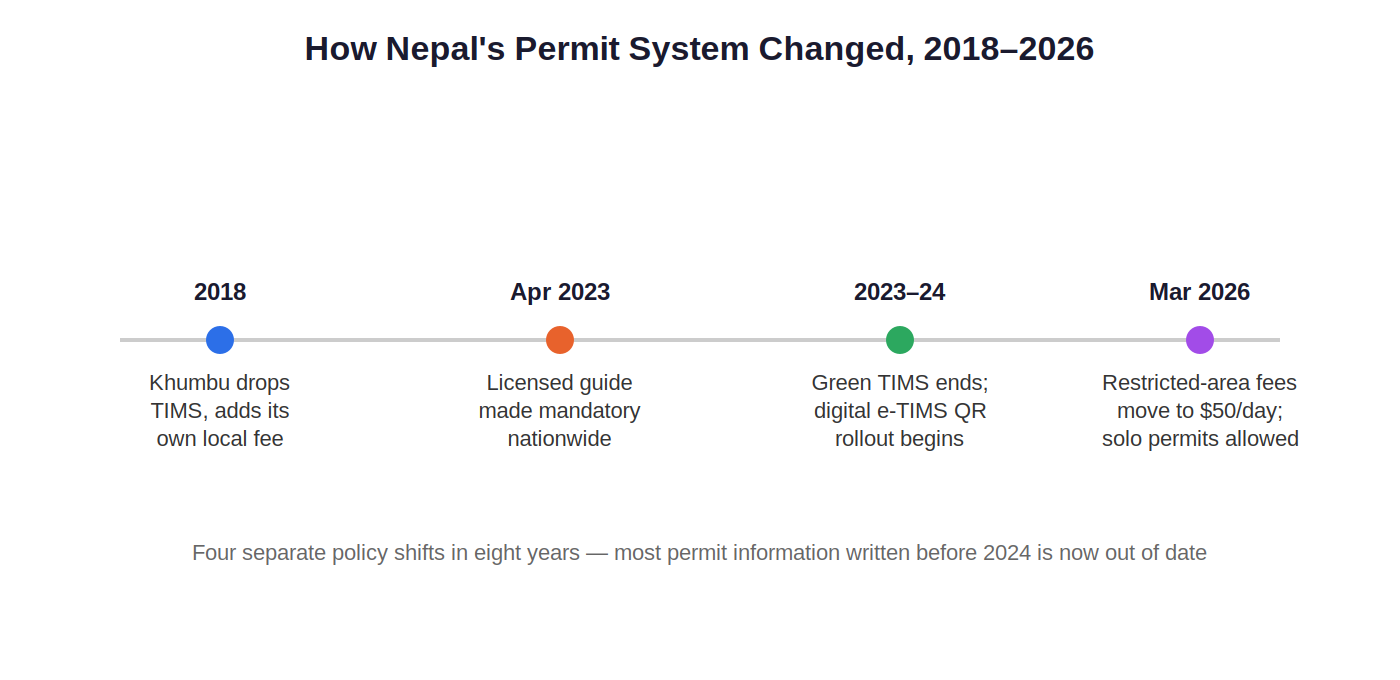
Ask five trekking agencies what permits you need for Nepal in 2026 and you'll get five slightly different answers — not because anyone's being careless, but because the system has genuinely been rewritten three times in the last three years. The mandatory guide rule landed in April 2023. The Khumbu region broke away from the national TIMS system back in 2018 and is still tightening its own local fees. And in March 2026, the Department of Immigration quietly dropped two rules that had defined restricted-area trekking for over a decade. If the last permit guide you read is more than a year old, some of it is probably wrong.
Here's what's actually true right now, region by region, with the fees that are current as of this year rather than carried over from an old post.
Source: Nepal Tourism Board, Department of Immigration, 2026 operator reporting
The system, in plain terms
Nepal's permit structure works in layers, and which layers apply to you depends entirely on where you're going.
Almost every trekking route needs some form of area entry permit — a national park fee, a conservation area fee, or both. On top of that, most regions outside the Khumbu still expect a TIMS card. And if your route runs near the Tibet or India border — Upper Mustang, Manaslu, Dolpo, Nar Phu, Tsum Valley, parts of Kanchenjunga — you'll need a Restricted Area Permit as well, issued not by the tourism board but by the Department of Immigration itself.
Threaded through all of it is the guide requirement. Since April 2023, every foreign trekker entering a national park, conservation area, or restricted zone has been legally required to hire a licensed guide through a registered agency. Independent trekking without one — the way a huge number of people did the Annapurna Circuit or Poon Hill for decades — is no longer permitted on paper, and by most accounts checkpoint enforcement in 2026 is considerably tighter than it was even a year ago.
What actually happened to the TIMS card
The Trekkers' Information Management System card used to be simple: you'd walk into the Nepal Tourism Board office in Kathmandu or Pokhara, fill out a form, pay a small fee, and get a laminated card recording your route and emergency contact. That version — the independently-obtained Green TIMS card — effectively stopped existing once the 2023 guide mandate came in, because the card is now issued only through registered trekking agencies as part of booking a guide.
The Blue TIMS card is what's left, and it still applies across most of the country: Annapurna, Langtang, and the general trekking regions that aren't Everest or a restricted zone. It typically runs NPR 1,000 for trekkers going through an agency and NPR 2,000 for those applying independently, and it's increasingly issued as a digital e-TIMS record — a QR code tied to your passport rather than a physical card — that checkpoints scan instead of inspect.
Where it gets genuinely murky is enforcement. Some 2026 reporting suggests TIMS checkpoints in Annapurna and Langtang aren't being staffed as consistently as they were a couple of years ago, and a few operators now describe it as being phased out in practice even though it hasn't been formally cancelled. Others insist it's still very much required and checked. The honest answer is that this is one of the few genuinely unsettled corners of the permit system right now, and the safest move is to let your registered agency confirm the current status for your specific route rather than trusting any single blog post — including this one — to have the final word.
Everest is its own country, permit-wise
The Khumbu region doesn't play by the national TIMS rules at all, and hasn't since 2018. Instead of a TIMS card, trekkers heading toward Everest Base Camp, Gokyo, or the Three Passes route need two local permits:
Sagarmatha National Park Entry Permit — NPR 3,000
Khumbu Pasang Lhamu Rural Municipality Permit — NPR 2,000 to 3,000, depending on the source you check
Combined, that's roughly NPR 6,000, or somewhere in the neighborhood of US$45 to $50. Neither permit is arranged in advance in Kathmandu — both are checked physically on the trail. The national park permit is typically stamped at Monjo, just below Namche Bazaar; the municipality permit is checked either there or back at Lukla, depending on which direction you're walking and which season it is.
The municipality fee itself is a relatively recent addition. It was introduced after 2018 specifically to fund local infrastructure in the Khumbu — trail maintenance, waste management, emergency services — separate from the national park's conservation budget. Worth noting for 2026: with October crowding becoming a recurring headache, there's reporting that the rural municipality has been trialing some form of trekker cap during the busiest weeks of peak season. If that's the kind of thing that could affect your dates, it's worth asking your agency directly rather than assuming the trail works exactly the way it did five years ago.
Annapurna, Langtang, and everywhere else
Outside Khumbu, the national-park-and-conservation-area layer looks a little different by region but follows the same basic logic. Annapurna Conservation Area Permit (ACAP) runs about NPR 3,000, and it's paired with the Blue TIMS card described above. Langtang National Park works similarly, with its own entry fee plus TIMS.
None of these permits are especially expensive on their own — the sticker shock in Nepal trekking budgets almost never comes from the paperwork. It comes from guide and porter wages, Lukla or Jomsom flights, and teahouse costs stacking up over a two-week itinerary. The permits themselves are a rounding error by comparison.
Restricted areas: the rules that changed in March 2026
If you're headed somewhere near the Tibetan border, the picture is different, and it's also where the most consequential change of the year happened.
For most of the last decade, Upper Mustang and Upper Dolpo carried a flat fee — US$500 covering your first 10 days in the restricted zone, then US$50 per additional day — regardless of whether your actual itinerary needed all ten. On March 22, 2026, the Department of Immigration scrapped that structure in favor of a straight US$50-per-person, per-day rate. A five-day visit to Lo Manthang now runs roughly $250 in permit fees instead of $500; a shorter Tiji Festival trip costs proportionally less too. Manaslu and Tsum Valley run on a separate weekly structure — around $100 per week during the September-to-November peak season, dropping to about $75 per week the rest of the year, with a smaller daily add-on beyond the first week.
The same March 2026 update also removed the long-standing rule that restricted-area permits needed a minimum of two trekkers. Solo travelers can now apply individually for Upper Mustang, Manaslu, and Kanchenjunga permits — though "solo" still means solo-with-a-licensed-guide, not solo-with-nobody. The guide requirement was never on the table in this update; only the group-size and pricing structure changed.
Restricted area permits still can't be picked up on the spot. They're processed through the Department of Immigration in Kathmandu by a registered agency, generally a couple of weeks ahead of your trek, which is one more reason restricted-area trips need to be locked in earlier than a standard Annapurna or Everest itinerary.
What it costs to permit three different treks
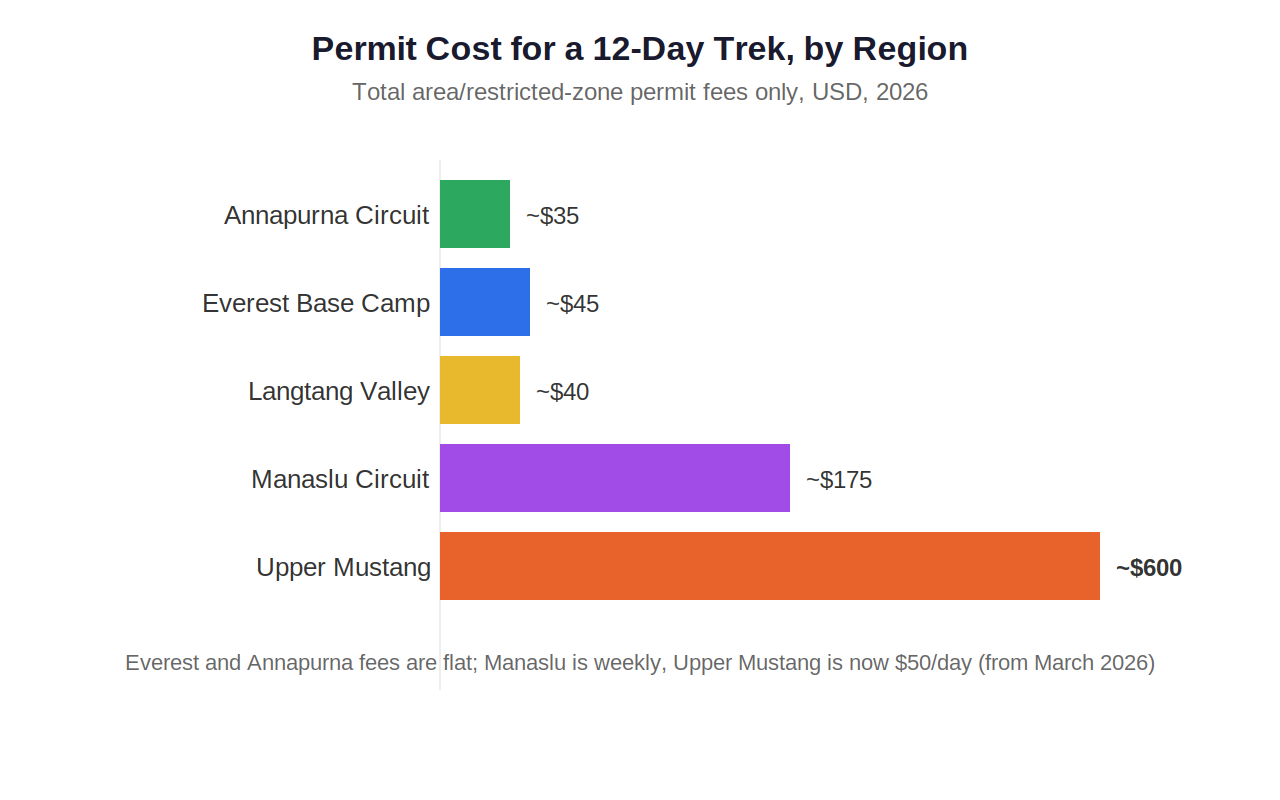
Put side by side, the gap between regions is bigger than most first-time trekkers expect. A standard 12-day Everest Base Camp trek costs about NPR 6,000 (~$45) in permits alone — the Sagarmatha and Khumbu fees described above, nothing more. A comparable Annapurna Circuit trek runs slightly less on paper: ACAP at roughly NPR 3,000 plus a Blue TIMS card at NPR 1,000 to 2,000, landing somewhere around $30 to $40 total. A 12-day Upper Mustang trip, by contrast, now runs $600 in restricted-area fees alone under the new $50-a-day rate — before guide costs, flights, or anything else. Restricted regions were always going to cost more; the point is that the multiple isn't small. It's roughly fifteen times the permit cost of Everest for a trek of similar length.
Composite of NTB, DoI, and 2026 operator permit guides
What actually happens if you skip one
Checkpoints along Nepal's major routes aren't decorative. Trekking without the required permit or without a licensed guide has historically carried an on-the-spot fine in the range of NPR 10,000 to 12,000, and being turned back at the checkpoint entirely is a realistic outcome rather than a scare tactic — agencies that skip permits for clients also risk fines and, in repeat cases, having their registration pulled. The 2026 difference isn't the penalty structure, which hasn't changed much; it's that more checkpoints are actually staffed and actually checking. A few restricted-area entry points have added biometric scanning this year specifically to close the gap where paperwork used to get waved through on a quiet afternoon. None of this is a reason to panic about a routine, agency-booked trek — it's a reason not to try to save $45 by skipping the Khumbu municipality fee on the theory that nobody checks anymore. Increasingly, somebody does.
The guide rule ties it all together
It's easy to read all of this as a permit-fee story, but the more consequential shift of the last three years is arguably the guide mandate itself. Before April 2023, a reasonably fit, reasonably prepared trekker could show up in Kathmandu, buy a TIMS card, and walk most of Nepal's classic routes — Annapurna Circuit, Poon Hill, Langtang Valley, even Everest Base Camp — without hiring anyone. That option is gone for foreign nationals on regulated routes. A licensed guide, booked through a government-registered agency, is now a legal requirement rather than a recommendation, and checkpoints in 2026 are checking guide credentials alongside permits far more consistently than they were even two years ago.
The financial impact is real but not enormous — a licensed guide typically runs $25 to $40 a day, more for a senior guide on a technical route — and for most first-time trekkers it was already the sensible choice regardless of what the law required. Where it changes the calculation is for the small population of experienced trekkers who genuinely preferred going alone. That option, at least on paper, doesn't exist anymore on any permit-controlled route in the country.
Getting the paperwork right without overthinking it
None of this is something you need to manage personally, in practice. A registered trekking agency handles TIMS registration, national park and conservation permits, restricted-area applications, and guide licensing as one bundled process — you provide a passport copy and a couple of photos, and the paperwork gets sorted before you land in Kathmandu. The one thing worth doing yourself is asking directly, before booking, whether your quoted price includes every permit your specific route requires. "All permits included" sometimes quietly excludes the newer municipality fees or restricted-area costs, and that's a cheaper problem to catch over email than at a checkpoint.
Given how much has shifted just in the past year — the Khumbu's ongoing fee adjustments, the March 2026 restricted-area overhaul, the tightening enforcement of the guide rule — the single most useful thing you can do is confirm the current numbers with your agency close to your actual travel dates, rather than locking in a budget off a permit guide (again, including this one) written months earlier.