
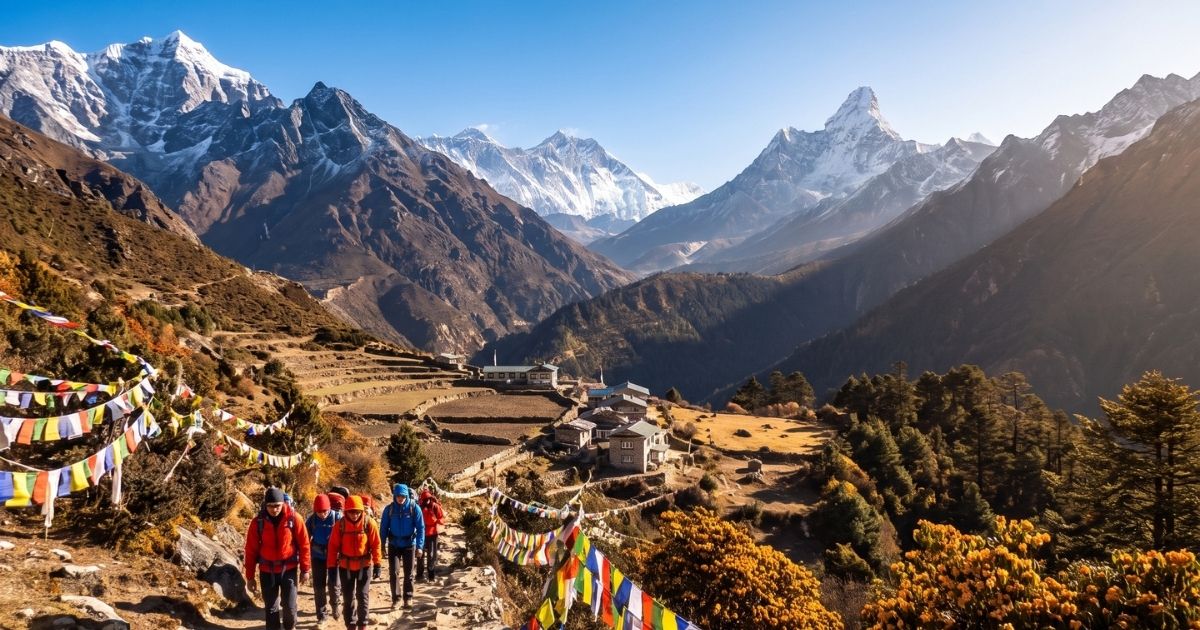
Every year, the monsoon clears out of the Khumbu by late September and leaves behind three or four weeks of the most reliable mountain weather Nepal sees all year. That window — October into November — is why autumn books out faster than any other season on the Everest Base Camp trail, and why teahouses from Namche to Gorak Shep are already filling up for 2026.
| TL;DR: Autumn (late September–November) is the single best season for the Everest Base Camp trek, with daytime temperatures around 12–17°C (54–63°F), the year's clearest mountain visibility, and dry trails. October is the busiest month; late October through mid-November offers nearly identical weather with lighter crowds. Lukla flights get booked out weeks ahead, and 2026 permit costs sit at roughly NPR 6,000 (~US$45) per person, with no TIMS card requ |
Key Takeaways October and November are Nepal's peak trekking months, prized for clear skies and fresh air as the monsoon dissipates by late September. Daytime temperatures on the trail typically run between 12°C and 20°C, dropping sharply after dark, especially above 4,000m. Everest Base Camp permits for 2026 total roughly NPR 6,000 (about US$45) per person, and the TIMS card is no longer required in the Khumbu. Late October and November trade a small amount of festival-season buzz for meaningfully shorter lodge queues and easier bookings. |
When Does Autumn Trekking Season Actually Start and End?
Autumn trekking in the Khumbu runs from roughly mid-September through the end of November, with the highest-quality window concentrated in October and the first half of November. The season kicks off in late September as the monsoon dissipates, and conditions hold steady until winter cold starts creeping in during the final week of November.
September itself is a transition month. Early September still carries leftover monsoon humidity and occasional afternoon cloud, but by the third week the skies clear noticeably. Most operators consider the last ten days of September the true opening of the autumn window, which is also when advance bookings for October departures typically close out.
November is the quieter half of the season. Some operators now consider November the single best month for the trek, thanks to a combination of warm days, cool nights, and reliably sharp mountain views — a shift attributed partly to monsoon patterns that now sometimes stretch further into October than they used to. [INTERNAL-LINK: full month-by-month Everest weather breakdown → seasonal weather hub page]
By early December, temperatures fall fast enough that most agencies shift their default recommendation toward winter gear and shorter daylight planning, which effectively closes the autumn window.
What's the Weather Like in October vs. November on the EBC Trail?
The short answer: October is milder and busier, November is colder and clearer. As the monsoon retreats in early September, the air is left incredibly clear, and by late September through October and November, conditions become the most stable of the year.
At mid-altitude villages like Namche Bazaar, October daytime temperatures generally range from 12°C to 16°C, dropping to between 5°C and -14°C overnight. Push higher toward Base Camp itself and the swing gets sharper — Base Camp daytime temperatures run roughly -5°C to 5°C, with nights falling to -10°C or colder.
November follows the same pattern but colder. Evenings at Base Camp can reach -10°C or below by November, and the monsoon has fully disappeared with generally clear skies, even though winter hasn't yet taken full hold of the high valleys. The trade-off is worth it for most trekkers: less humidity in the air means sharper peaks, especially of Ama Dablam and the Everest massif from Kala Patthar.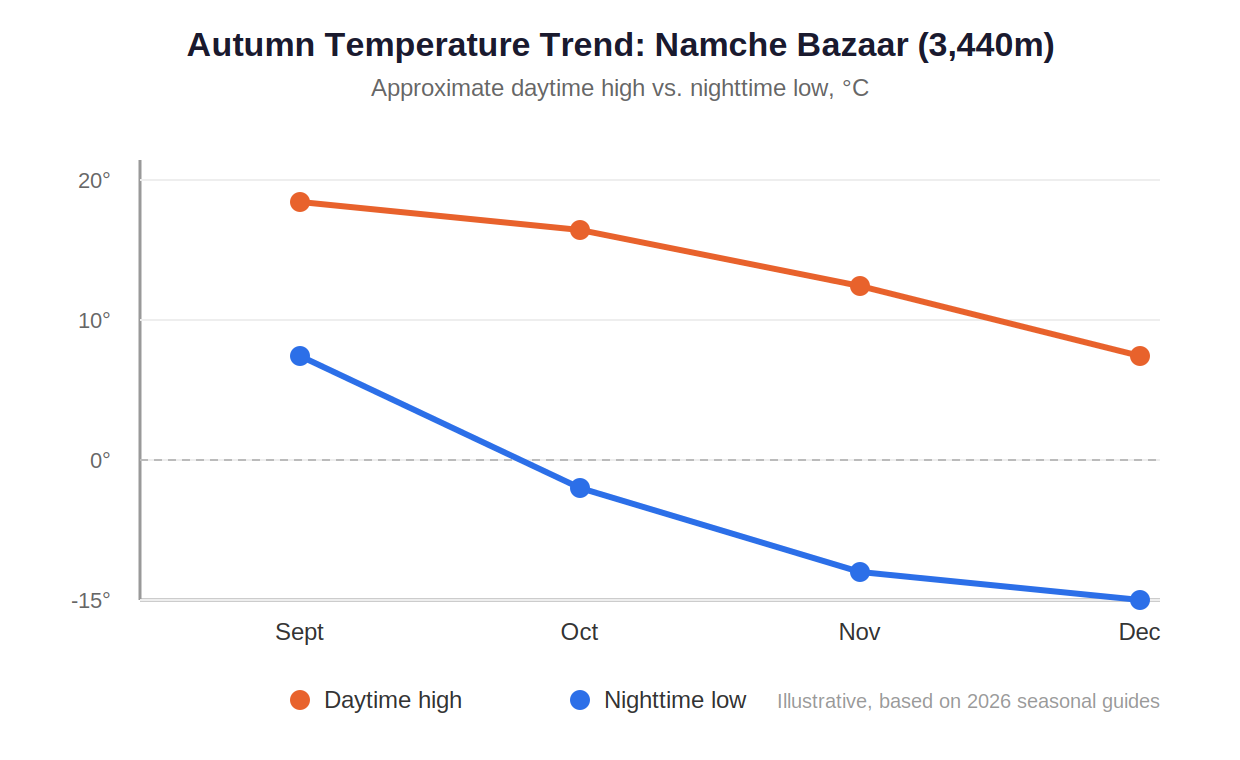
Source: aggregated from Ace the Himalaya, EverTrek, and Himalayan Recreation seasonal guides, 2026
Why Is Autumn the Busiest Season on the Trail?
Autumn draws the biggest crowds of the year because it combines the best weather with Nepal's biggest festivals. October in particular is peak season, and tea houses and lodges along the route can fill up quickly, leaving no room even on weekends. The season also overlaps with Nepal's biggest festivals, Dashain and Tihar, which brings extra cultural texture but also pulls more domestic and international travelers onto the trail at once.
Rhetorical question worth asking before you book: do you want the liveliest teahouses of the year, or the quietest clear-sky window? Both exist inside "autumn" — you just have to pick your week. November sits at the tail end of autumn, after the monsoon has cleared and before winter fully takes hold, and tends to offer a more relaxed atmosphere than the busiest part of the season.
[INTERNAL-LINK: how crowded is the EBC trail in October → trail crowding and teahouse booking guide]
Practical effect of the crowding: lodge owners in Dingboche, Lobuche, and Gorak Shep sometimes double up rooms or move overflow guests into dining halls during the first three weeks of October. Booking teahouses two to three months ahead, or trekking with an agency that pre-reserves rooms, matters more in autumn than in any other season.
How Much Does the Everest Base Camp Trek Cost in Autumn 2026?
A standard 12–14 day guided EBC package for autumn 2026 typically runs between $1,400 and $2,500, covering permits, a licensed guide, a porter, teahouse accommodation, most meals, and domestic flights. Independent trekkers without a guide or porter can get by on the lower end of that range, though most first-time trekkers opt for the guided option for logistical support and safety at altitude.
Three-line items drive most of the variation between operators: the Kathmandu–Lukla flight, guide and porter wages, and food. Round-trip Lukla flights currently run $350 to $420 and rise fastest during peak autumn weeks, since seats sell out early. A certified guide charges roughly $35–$40 per day, and a porter around $22–$25 per day. Daily food costs on the trail run about $25–$40, and climb higher, where everything arrives by porter or yak.
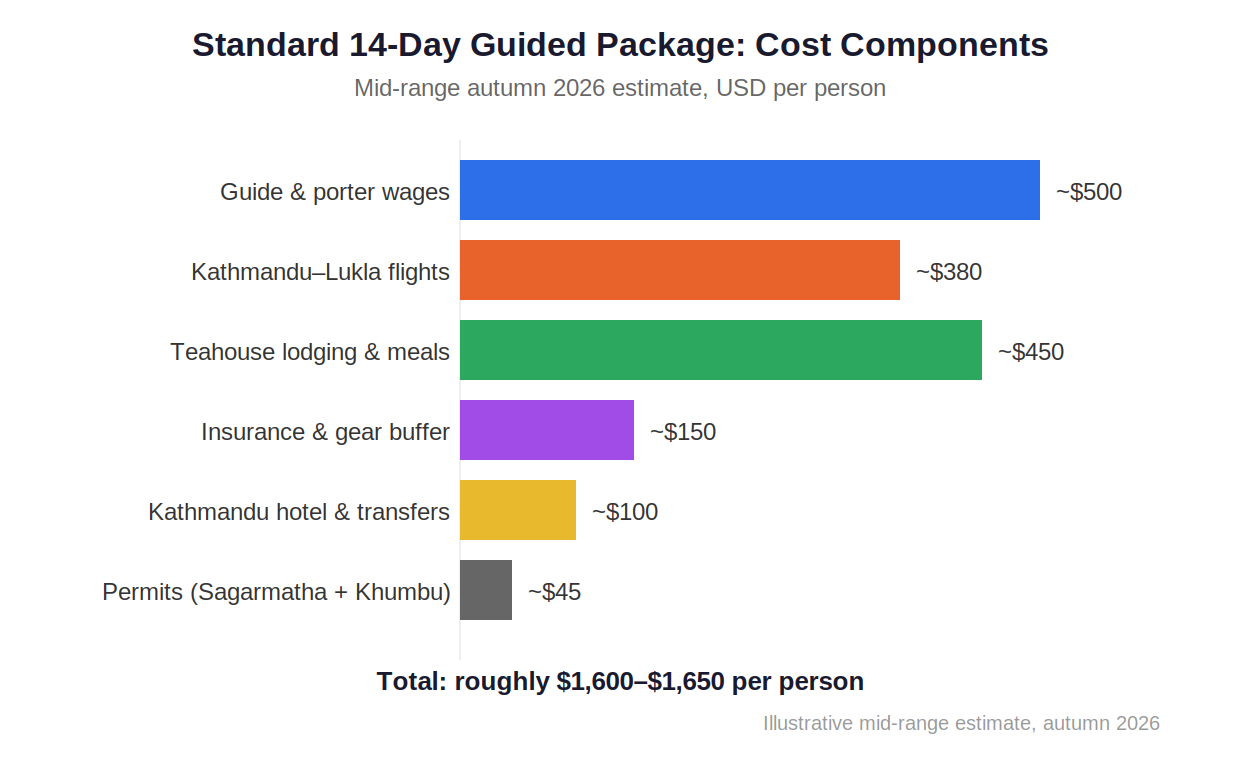
Source: composite of Buddy the Traveling Monkey, Everest Thrills, Mountain Hawk Trek, and Awesome Holidays Nepal cost guides, 2026
[INTERNAL-LINK: see our all-inclusive Everest Base Camp trek packages for autumn 2026 → EBC package page]
What Permits Do You Actually Need for Autumn 2026?
You need exactly two documents for the standard Lukla-to-Base-Camp route in 2026, and the TIMS card is not one of them. The Sagarmatha National Park entry permit costs NPR 3,000, and the Khumbu Pasang Lhamu Rural Municipality permit costs another NPR 3,000, for a combined total of about NPR 6,000, or roughly US$45 per person.
In the Everest Base Camp and broader Khumbu region, the TIMS card is no longer required — the Khumbu Pasang Lhamu Rural Municipality replaced it with its own local entry fee. That's a genuinely useful thing to know before you go, since older guides and outdated blog posts still sometimes try to charge trekkers for a TIMS card they no longer need.
Both permits are issued only on the trail, not online and not in Kathmandu in most cases — the Khumbu permit is available at Lukla, and the Sagarmatha permit at Lukla during peak season or at Monjo year-round. If you're booking a guided trek, your agency will typically handle both purchases as part of the package, so this is one less thing to manage on arrival day.
[INTERNAL-LINK: complete Nepal trekking permit guide → permits and regulations hub]
How Should You Plan Around Lukla Flight Delays During Peak Season?
Lukla flights are the single biggest wildcard in an autumn EBC itinerary, and building in buffer days is not optional if you want a stress-free trip. Around 30–40% of flights get cancelled during peak season months including October and November, with cancellation rates exceeding 60% during the monsoon.
The mechanics matter here: only about 10–15 flights operate daily under favorable conditions, and aircraft carry roughly 16–19 passengers each, so a single bad-weather morning can back up hundreds of trekkers at once. Flights to Lukla mostly operate before noon, since afternoon weather makes landing far more difficult, which is why early departures matter more than flight choice itself.
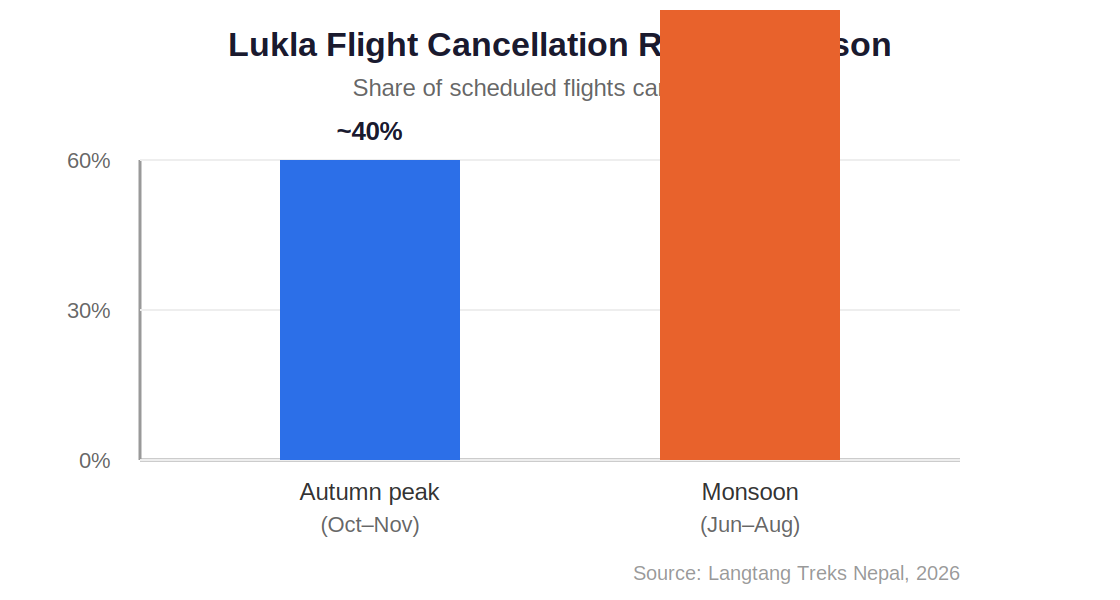
Source: Langtang Treks Nepal Lukla flight guide, 2026
Build in at least one, ideally two, buffer days at the end of your itinerary before your international flight home. Many agencies now route peak-season flights through Ramechhap's Manthali Airport instead of Kathmandu to reduce congestion — worth asking your operator whether this applies to your dates. [INTERNAL-LINK: Ramechhap vs Kathmandu Lukla flights explained → Lukla flight routing guide]
What's the Ideal Itinerary Length for an Autumn 2026 Trek?
Twelve to fourteen days on the trail is the standard window, and autumn is exactly the season where you don't want to shave days off that plan to save money. Extra buffer days matter because Lukla flight delays are common in bad weather, and a group can't safely complete a 12-day trek if a day is lost waiting for planes to fly.
A realistic 14-day structure looks like: 2 days in Kathmandu (prep and permit buffer), a fly-in day to Lukla with a short walk to Phakding, gradual ascent through Namche Bazaar and Tengboche with two built-in acclimatization days, a push to Base Camp via Dingboche, Lobuche, and Gorak Shep, and a faster descent back to Lukla with a buffer day before flying out.
Trekkers who compress this into 10 or 11 days during autumn's crowded weeks run the highest risk of missing acclimatization days entirely if a Lukla delay eats into the schedule. [INTERNAL-LINK: sample 14-day EBC itinerary day by day → itinerary planning page]
A shorter itinerary isn't necessarily reckless on its own — it becomes reckless when it removes the acclimatization buffer rather than the sightseeing buffer. If your schedule is tight, the day to protect is the second rest day at Dingboche, not the extra night in Kathmandu. Guides who've worked the autumn season for years generally agree that the single biggest driver of turned-back trekkers isn't fitness, it's ascent speed above 4,000m.
Worth noting too: autumn's clear skies create a specific temptation that spring and winter don't. When Ama Dablam and Everest are fully visible from Tengboche or Dingboche, groups sometimes push an extra hour or two to reach the next village before dark, effectively gaining altitude faster than planned. That instinct is understandable, but it works against the acclimatization schedule your itinerary was built around. Treat good visibility as a reason to take photos, not a reason to move faster.
Packing for Autumn Conditions
Autumn's day-to-night temperature swing is the single biggest packing consideration. A trekker comfortable in a light fleece at midday in Namche Bazaar can be reaching for a down jacket within two hours of sunset at the same elevation. Layering, rather than one heavy jacket, handles this swing better because you're adding and removing pieces throughout the day rather than sweating through a single bulky layer.
A four-season sleeping bag rated to at least -15°C is standard advice for autumn, even though daytime temperatures rarely feel that extreme — teahouse rooms above Namche are unheated, and the rating needs to cover the coldest night of the trip, not the average one. Sun protection matters more than most first-time trekkers expect: the same clear skies that make autumn photogenic also mean stronger UV exposure at altitude, so sunglasses rated for glacier conditions and a high-SPF sunscreen belong on every autumn packing list.
How Do You Avoid Altitude Sickness on an Autumn Trek?
The clear, dry air of autumn doesn't reduce altitude risk — thinner oxygen at 4,000m+ is the same regardless of season, and the crisp weather can actually tempt trekkers to move faster than they should. The standard safeguard is the same every season: ascend gradually, and never skip a scheduled acclimatization day just to make up time lost to a flight delay.
Practical steps that matter most in autumn specifically: keep at least two full rest days above 3,400m (typically at Namche Bazaar and Dingboche), drink more water than feels necessary since the dry autumn air accelerates dehydration, and avoid the temptation to rush the clear-sky stretch between Namche and Dingboche just because visibility is good. A pulse oximeter, now carried by most licensed guides, gives an objective early warning before symptoms become serious.
[INTERNAL-LINK: full altitude sickness prevention guide for the EBC trek → altitude and acclimatization resource]
Autumn vs. Spring: Which Season Should You Choose?
Autumn and spring are the two peak seasons for a reason, and the choice mostly comes down to what you want to see. Spring, covering March, April, and May, brings warmer daytime temperatures ranging from about 18°C to 30°C at lower elevations, plus blooming rhododendron forests lower on the trail — something autumn simply doesn't offer.
Autumn's advantage is visibility and stability. Post-monsoon air carries far less haze than spring's pre-monsoon dust, which tends to build up through April and May. If sharp, unobstructed photos of Everest and Ama Dablam are the priority, autumn wins. If warmer temperatures and forest color are the priority, spring wins. Crowds and pricing are roughly comparable in both seasons, so neither has a meaningful cost advantage.
Late November and early December, and their spring equivalent of late February through early March, offer a middle path: similar clear-sky benefits with noticeably thinner crowds, at the cost of colder temperatures.
Ready to Book Your Autumn 2026 Trek?
Autumn 2026 departure slots for October, historically the single busiest month on the trail, tend to sell out or fill teahouse allocations 8 to 10 weeks ahead of the trek start date. If clear skies and manageable crowds matter more than saving a few dollars on the shoulder season, aim to lock in your Lukla flight and teahouse bookings by early September at the latest.
[INTERNAL-LINK: browse and book our Everest Base Camp trek packages for autumn 2026 → EBC package page]
Frequently Asked Questions
Is October or November better for the Everest Base Camp trek?
Both are excellent, but they suit different priorities. October is the top-choice month for most travelers because the weather is neither too hot nor too cold, though it also means the heaviest crowds of the year. November trades slightly colder nights for thinner crowds and, according to some operators, even sharper mountain visibility.
Do I need a TIMS card for the EBC trek in autumn 2026?
No. The TIMS card is not required for the Everest Base Camp trek in 2026 — trekkers only need the Sagarmatha National Park Entry Permit and the Khumbu Pasang Lhamu Rural Municipality Permit, together costing about US$45 per person.
How likely are Lukla flight delays in October and November?
Fairly likely, so plan around it rather than hoping to avoid it. Roughly 30–40% of Lukla flights are cancelled during peak season, which includes October and November. Booking early morning flights and adding at least one buffer day at the end of your trip significantly reduces the risk of missing an international connection.
How much should I budget for an autumn 2026 EBC trek?
Most guided 14-day packages fall between $1,400 and $2,500, covering permits, guide, porter, teahouse lodging, most meals, and domestic flights. Add roughly $150–$300 for travel insurance with high-altitude evacuation coverage, gear rental, and personal spending money.
Is autumn too crowded for a good EBC trekking experience?
October is genuinely the busiest month of the year on the trail, but the crowding is concentrated in specific villages and specific weeks rather than the entire route. Shifting your start date to late October or the first half of November keeps the same weather quality while noticeably thinning out lodge queues and trail traffic.
The Bottom Line
Autumn remains the benchmark season for the Everest Base Camp trek, and 2026 doesn't change that calculus — clear skies, dry trails, and manageable daytime temperatures from late September through November make it the safest bet for a first-time high-altitude trekker. The trade-offs are practical, not seasonal: book Lukla flights and teahouses early, pad your itinerary with buffer days for weather delays, and pick your exact window (peak October crowds vs. quieter November clarity) based on what matters more to you personally.